AI vs UI
The rapid ascent of Artificial Intelligence (AI) marks a pivotal epoch in human history, offering unprecedented capabilities in data processing, automation, and problem-solving. Yet, amidst the marvels of algorithmic advancement, a critical discourse emerges concerning its interplay with what we term Universal Intelligence (UI)—the innate human capacity for general thinking,
3/8/20261 min read
Nurturing Universal Intelligence in the Age of AI
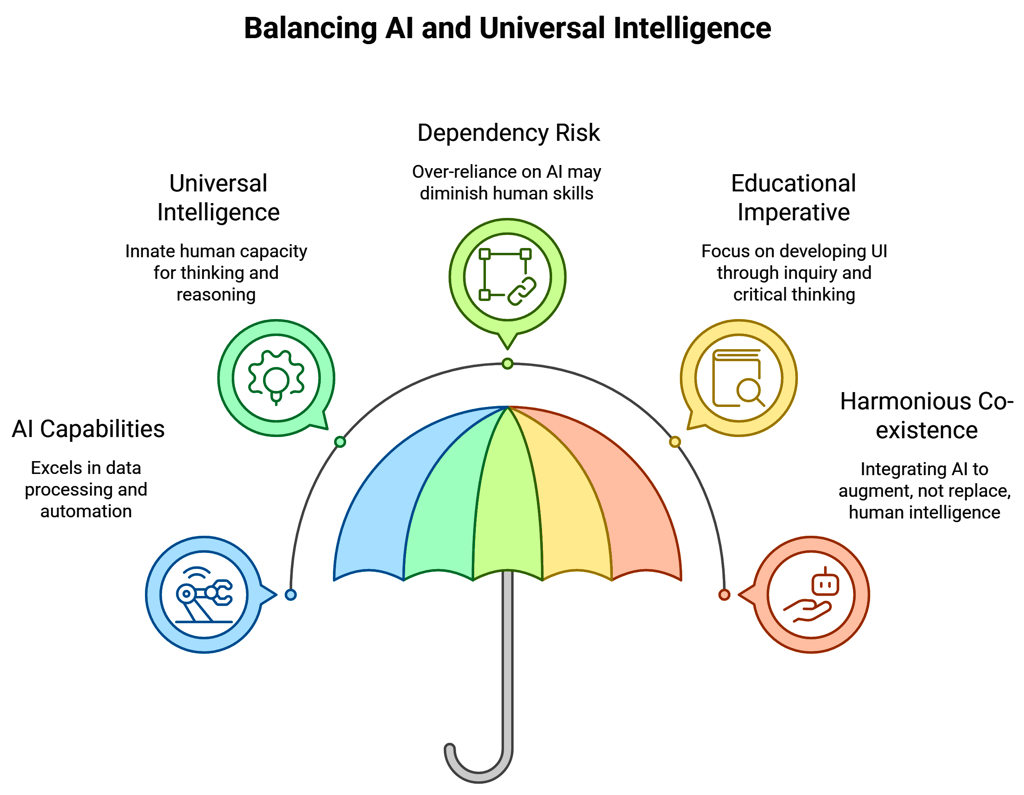
The rapid ascent of Artificial Intelligence (AI) marks a pivotal epoch in human history, offering unprecedented capabilities in data processing, automation, and problem-solving. Yet, amidst the marvels of algorithmic advancement, a critical discourse emerges concerning its interplay with what we term Universal Intelligence (UI)—the innate human capacity for general thinking, common sense, ethical reasoning, and intuitive understanding. While AI excels in specific, well-defined tasks, the present generation faces the profound challenge of preserving and enhancing UI, which underpins creativity, critical thought, and adaptive reasoning.
The profound accessibility of AI tools, from sophisticated language models to advanced analytical engines, risks fostering a dependency that may inadvertently diminish the cultivation of inherent human cognitive potential. If tasks traditionally requiring critical analysis, nuanced interpretation, or even basic logical deduction are consistently offloaded to AI, there is a legitimate concern that individuals may not fully develop their own capacities for independent thought and problem-solving. This reliance could lead to a subtle erosion of common sense and the intuitive faculties essential for navigating complex, ambiguous, and ethically charged real-world scenarios that AI, by its nature, cannot fully grasp.
Therefore, the imperative for educators and societal frameworks is to consciously re-emphasize the development of UI. This involves cultivating environments that promote genuine inquiry, foster independent critical thinking, encourage ethical deliberation, and provide ample opportunities for experiential learning. The goal is not to resist AI, but to integrate it judiciously—as a powerful tool that augments, rather than supplants, human intelligence. By championing UI, we ensure that future generations remain agile, innovative, and ethically grounded, capable of harnessing AI's power while safeguarding the distinct essence of human ingenuity. The harmonious co-existence of AI and UI is paramount for a future where technology truly serves humanity's highest potential.